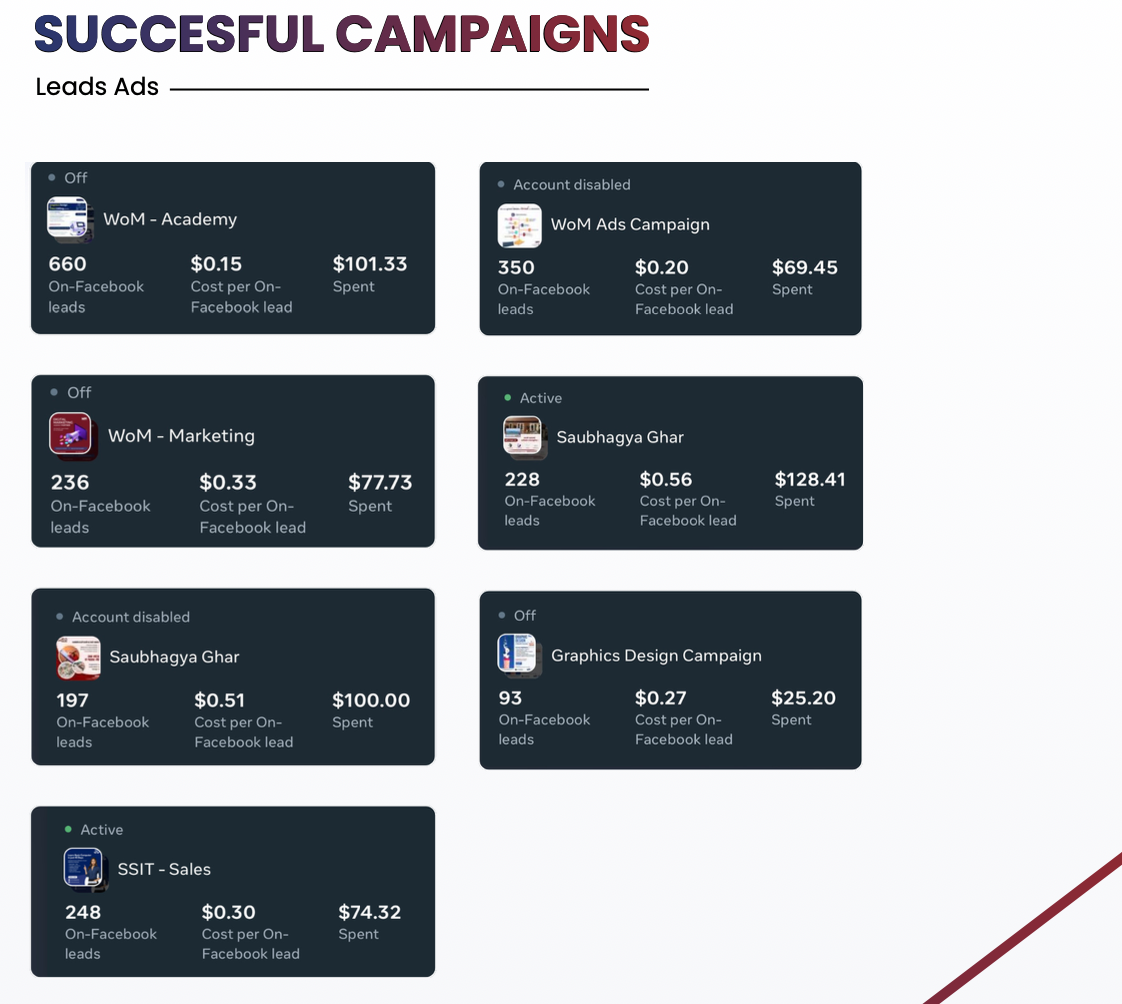
What the source image verifies
The attached historical Ads Manager screenshot records a lead campaign with the following platform-reported results:
The cost-per-lead figure is consistent with the other two numbers after rounding. This is stronger evidence than a marketing claim because a reader can compare the written summary with the source image.
What the screenshot does not verify
It does not show lead quality, booked meetings, closed customers, collected revenue or profit. It also does not show the campaign date range, attribution setting or how duplicates and invalid enquiries were handled.
An earlier version of this article claimed that $82 produced 23 leads and $9,000 in revenue. Those figures do not match the attached campaign evidence, so they have been removed rather than presented as verified outcomes.
How to read a low-cost lead campaign
Low CPL can be useful, but it is only the first layer of the funnel. A Nepal business should review at least four stages:
- Platform lead — The form was submitted inside Facebook or Instagram
- Valid lead — The contact details and intent are real
- Qualified opportunity — The person fits the offer and can buy
- Business outcome — A meeting, order or collected payment happened
The campaign becomes commercially meaningful only when the team records what happens after the form submission.
The operating method
Make the first step clear
The form should explain what the person will receive and what happens next. A vague “learn more” promise can produce cheap but confused enquiries.
Ask only what the team will use
Every extra field adds friction. Ask enough to route and qualify the enquiry, then collect deeper context during follow-up.
Contact leads while intent is fresh
Agree on an owner, response window and follow-up sequence before launching. The ad team cannot repair a lead pipeline that nobody works.
Report business quality beside platform cost
Track valid-lead rate, qualified-lead rate, appointment rate and customer outcome beside CPL. This prevents the cheapest campaign from being mistaken for the best campaign.
The practical conclusion
This example proves that Meta can generate inexpensive form submissions in the tested setup. It does not prove $9,000 in revenue or guarantee the same cost for another account. The next useful question is whether those leads became valuable business conversations.
Read the broader Meta Ads consulting approach for Nepal businesses or share your campaign context.